Clutch & Drivetrain
Subaru's symmetrical AWD is one of the most capable systems on the road — and one of the most unforgiving when the drivetrain is neglected. We service it correctly.
The Whole System.
Done by People Who Know It.
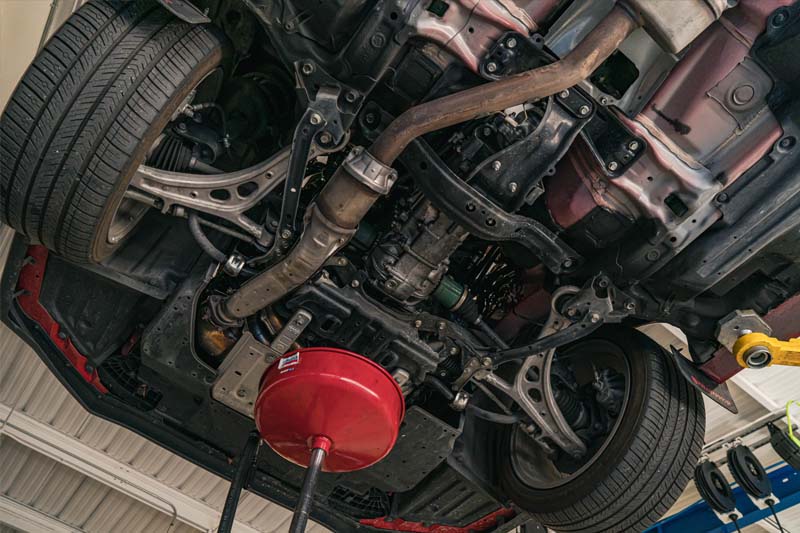
Subaru's drivetrain is not a standard front-wheel-drive platform with power added to the rear as an afterthought. The symmetrical AWD layout means the front differential, center differential, transfer case, driveshaft, rear differential, and all four CV axles are part of one integrated system. A problem in one component changes how the rest behaves.
Clutch work on a manual Subaru requires the same holistic approach. A worn clutch disc is almost never the only worn component — the flywheel, pressure plate, throwout bearing, and pilot bearing all get evaluated while we're in there, because doing the job halfway means returning to it sooner than you should.
- Complete clutch system service — disc, pressure plate, throwout bearing, and pilot bearing
- Flywheel resurfacing done in-house — no outsourcing, no markup, no extra wait
- CV axle replacement with OEM-spec or OEM-equivalent parts
- AWD center differential, transfer case, and driveshaft diagnosis and repair
- Differential fluid inspection during every drivetrain service
- 2-year warranty on all parts and labor
What We Service
From the clutch pedal to the rear differential — every component in Subaru's drivetrain, diagnosed and repaired by people who know the system.
Clutch System
Complete clutch replacement covering the friction disc, pressure plate, throwout bearing, and pilot bearing. We inspect the flywheel face for heat discoloration, scoring, and hot spots — and resurface or replace it based on what we actually find. Doing a clutch job without evaluating the flywheel is how you get clutch chatter and a callback in 20,000 miles.
Flywheel Resurfacing
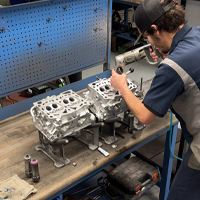
Our in-house machine shop handles flywheel resurfacing on-site. When the flywheel face is within spec and resurface-able, we machine it flat and smooth for proper pad break-in. When it's heat-cracked, scored below minimum, or showing deep hard spots, we tell you it needs replacement — not because it's more profitable, but because a compromised flywheel will ruin a new clutch disc.
CV Axles & Boots
CV axles are inspected at every multi-point inspection — torn boots accelerate joint failure by letting grease escape and contaminants in. When a boot is torn but the joint still has life, we replace the boot. When the joint is already clicking, grinding, or vibrating under load, we replace the axle. Lifted Subarus and those running non-stock offset wheels wear CV axles significantly faster — a pattern we know well in this area.
Driveshaft
The rear driveshaft connects the transfer case to the rear differential through a center carrier bearing. Vibration at highway speed — particularly that appears or worsens above 55–60 mph — is often the first sign of a failing center bearing or imbalanced driveshaft. We diagnose the source and repair it correctly, rather than chasing vibration with tire rebalancing that won't fix the underlying issue.
Center Differential & Transfer Case
Subaru's center differential distributes torque between the front and rear axles — and it's sensitive to mismatched tire sizes and degraded fluid. Binding during low-speed turns, unusual drivetrain noise, or uneven tire wear across axles can all point here. We diagnose AWD binding and center differential wear properly, rather than attributing symptoms to tires or alignment when the source is deeper in the drivetrain.
Rear Differential
Rear differential mechanical service including bearing replacement, seal replacement, and differential rebuild when the unit itself has failed. This is separate from fluid maintenance — though neglected fluid is often what gets a differential to this point in the first place. If you've been told your rear differential is failing, bring it to us for a second opinion before authorizing a replacement. Some differential failures are repairable for significantly less than a full swap.
Subaru AWD Isn't Generic.
Neither Is How We Service It.
In-House Machine Shop
Flywheel resurfacing happens here — not at a third-party machine shop with a 2-day turnaround and an opaque markup. We machine flywheels in-house, which means faster turnaround, direct quality control, and no middleman cost passed to you. It also means we're making the resurface-vs-replace call ourselves, not relying on someone else's assessment.
Subaru AWD Specialists
We know the specific failure patterns across Subaru's AWD generations — the viscous coupling behavior in older models, the DCCD calibration on STIs, the VTD system in Legacys and Outbacks, the ACT system in CVT-equipped models. Each behaves differently under stress and each has different service requirements. A generalist shop treats them all the same. We don't.
2-Year Warranty
Every clutch component, CV axle, and drivetrain repair we perform is covered by our 2-year warranty. We use parts that meet or exceed OEM specification and we stand behind the work — including the flywheel machining done in-house. If something we repaired fails within that window, we make it right.
Clutch & Drivetrain FAQ
How do I know if my clutch is worn out?
The most common signs are slipping — the engine revs rise but the car doesn't accelerate in proportion — especially noticeable under hard acceleration or climbing hills in a higher gear. Clutch chatter (shudder on engagement from a stop) usually means a glazed or heat-damaged flywheel rather than a worn disc. Difficulty shifting, a dragging pedal, or a pedal that engages very high or very low in its travel are also indicators. If the clutch feels different than it used to, have it inspected before it leaves you stranded.
Do I need to replace the flywheel when I replace the clutch?
Not always — but it needs to be evaluated every time. A flywheel with scoring, heat cracks, or hard spots will glaze and ruin a new clutch disc within 10,000–20,000 miles. Resurfacing removes minor surface wear and restores proper friction — and since we machine flywheels in-house, it's a straightforward decision when the material is there. If the flywheel is too far gone to save, replacement is more cost-effective than installing a new clutch kit against a compromised surface.
My Subaru vibrates or shudders at highway speed — is that a drivetrain problem?
Possibly, and the distinction matters. Vibration from tires or wheel balance typically presents at a specific speed and can improve with rebalancing. Driveshaft vibration tends to be more persistent, often worsens in a specific RPM range rather than speed range, and won't be fixed by rotating tires. A failing CV axle typically produces a clicking or clunking noise during cornering under acceleration rather than a highway cruise vibration. We diagnose the source before recommending parts.
Can a tire size mismatch actually damage my Subaru's AWD?
Yes — and this is one of the most common avoidable drivetrain failures we see. Subaru's AWD system expects all four tires to rotate at the same speed. A significant difference in circumference — even a worn spare used briefly — forces the center differential to continuously compensate for the mismatch. Over time this creates heat, wear, and binding in the center differential. Subaru specifies that all four tires must be within 2/32" of tread depth from each other. If you've mixed tire sizes or run a mismatched spare for more than a short distance, have the AWD system inspected.
How long does a clutch replacement take?
A full clutch replacement on a Subaru — disc, pressure plate, throwout bearing, pilot bearing, and flywheel resurface — typically takes 5–7 hours. Plan to leave the car for the day. If flywheel replacement is needed instead of resurfacing, add time for part acquisition on some models. Loaner vehicles are available — mention it when you schedule and we'll have one ready so the job doesn't disrupt your day.