Brake Service
Brakes aren't a scheduled inconvenience — they're a safety system. We service them completely, document what we find, and don't replace parts that don't need replacing.
We Replace What's Worn.
Not What's Profitable.
Brake work is one of the most commonly over-sold services in the industry. Pads replaced when they had 30% life remaining. Rotors replaced when they should have been kept. Calipers swapped out when a slide pin service would have fixed the problem. We don't operate that way.
Every brake service starts with a full system inspection — pad thickness, rotor condition and minimum thickness, caliper function, brake hose condition, and fluid quality. We tell you what we find and what it means. If your brakes are good, we tell you that. If something genuinely needs attention, we tell you that too, with a clear explanation of why and what it costs.
- Full brake system inspection with every service — pads, rotors, calipers, hoses, and fluid
- Correct-spec pads for your Subaru — compound matched to your driving and braking demands
- Rotor replacement decision made on actual measurements, not assumptions
- Caliper slide pins cleaned and lubricated at every brake service
- Brake fluid condition checked and flagged if service is due
- 2-year warranty on all parts and labor
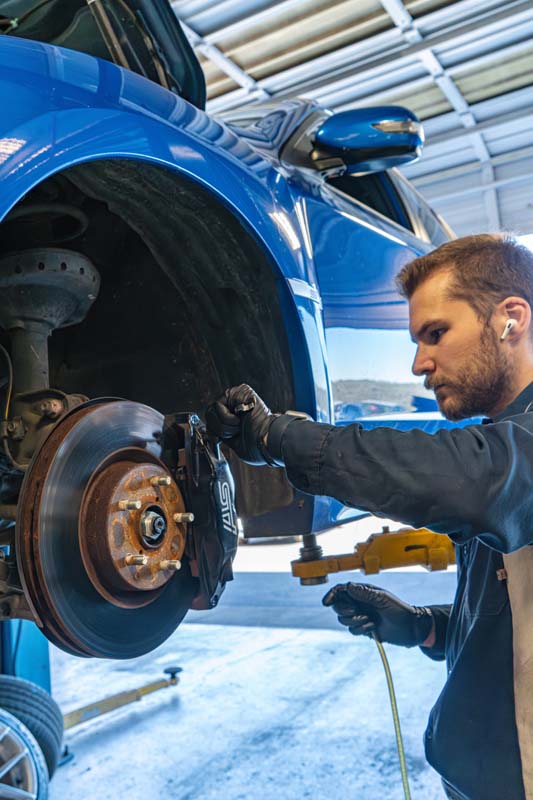
What a Complete Brake Service Covers
Brakes are a system — every component affects the others. We look at all of it.
Brake Pads
Front and rear pad thickness measured and documented. We use pads spec'd for your Subaru's weight, brake system, and intended use — not a generic economy pad that meets minimum friction requirements. For WRX, STI, and spirited drivers, we stock performance compound options that handle heat better without compromising street drivability.
Rotors
Rotor thickness measured against Subaru's minimum specification. Surface condition assessed for deep scoring, cracking, or heat spots. When rotors are below minimum thickness, deeply scored, or showing heat damage, we replace them. We measure against Subaru's specifications and replace when needed — not before, not after.
Calipers
Caliper pistons inspected for extension and retraction. Slide pins — the most commonly neglected part of a brake service — cleaned, inspected, and properly lubricated at every job. Seized or corroded slide pins cause uneven pad wear and pull braking force to one side. If a caliper needs rebuilding or replacement, we tell you exactly what it will cost before we touch it.
Brake Hoses & Lines
Rubber brake hoses are inspected for cracking, swelling, and internal delamination. Steel brake lines checked for corrosion at fittings and along the chassis. A hose that's deteriorating internally acts as a one-way valve — it lets fluid pressure build but won't fully release it, causing the caliper to stay partially applied and the pad to wear down fast on one side.
Brake Fluid
Fluid level and condition checked with every brake service. Brake fluid absorbs moisture over time, which lowers its boiling point and creates the risk of vapor lock under hard braking. If your fluid is due — Subaru recommends every 2 years — we'll note it and can combine a flush with your brake work in the same visit. See our Fluid Services page for more detail.
Brake System Bleeding
Any time a brake caliper is replaced or a hydraulic line is opened, the system needs to be properly bled to remove air from the lines. Air in a brake line is compressible — it creates a spongy, inconsistent pedal. We bleed all four corners when the job requires it and verify pedal firmness before the car leaves the shop.
Brake Work Done Right
Starts With Honest Diagnosis
Subaru-Specific Knowledge
Subarus have model-specific brake quirks — the rear brake adjustment procedure on drum-in-hat parking brake systems, the EyeSight system's brake actuator considerations, the different caliper designs across WRX and STI generations. We've seen the failure patterns, know the common oversights, and service each model correctly.
We Inspect Before We Quote
We don't quote brake service over the phone based on model year. Pad life, rotor condition, and caliper function vary too much between cars with identical mileage. We put the car on the lift, measure what needs measuring, and give you an accurate quote based on what your specific car actually needs — not a package designed to maximize ticket size.
2-Year Warranty
All brake parts and labor are covered by our 2-year warranty. Pads, rotors, calipers, and hardware — if anything we installed fails or was installed incorrectly within that window, we make it right at no charge. That's what standing behind brake work actually means.
Brake Service FAQ
How do I know if my brakes need service?
The clearest signs are squealing or grinding noise under braking, a pulsing or vibrating pedal, pulling to one side when you stop, or a longer-than-normal stopping distance. Squealing at first contact (especially when cold or wet) often indicates worn pad indicators doing exactly what they're designed to do. Grinding is metal on metal — that means you're past the pad and into the rotor. Either way, don't wait. If you're unsure, bring it in for an inspection. Our multi-point inspection checks brake condition at every oil change as a baseline.
Why are my brakes squealing even though the pads are new?
New brakes need a bedding-in period — typically a series of moderate stops from 40–45 mph that transfer an even layer of pad material onto the rotor surface. Squealing on brand-new pads is often glazing from improper break-in, low-quality pad material with inadequate shims, or rotors that weren't properly prepped before installation. If we did the work and your brakes are squealing, bring it back — that's what the warranty is for.
Do I need to replace front and rear brakes at the same time?
Not necessarily. Front brakes handle the majority of braking force — typically 70–80% on most vehicles — and wear considerably faster than rear brakes. It's common and completely acceptable to replace fronts independently of rears. The rule is to always replace both sides of the same axle at the same time (both fronts or both rears), since mismatched pad thickness causes uneven braking force and pull. Mixing axles is fine; mixing sides is not.
How long does brake service take?
A standard pad and rotor replacement on one axle takes 1–2 hours. Front and rear together is typically 2.5–3.5 hours. If we're also replacing calipers, bleeding the system, or doing brake line work, plan on a full day. We'll give you an accurate time estimate when you schedule, and loaner vehicles are available for jobs that run longer.