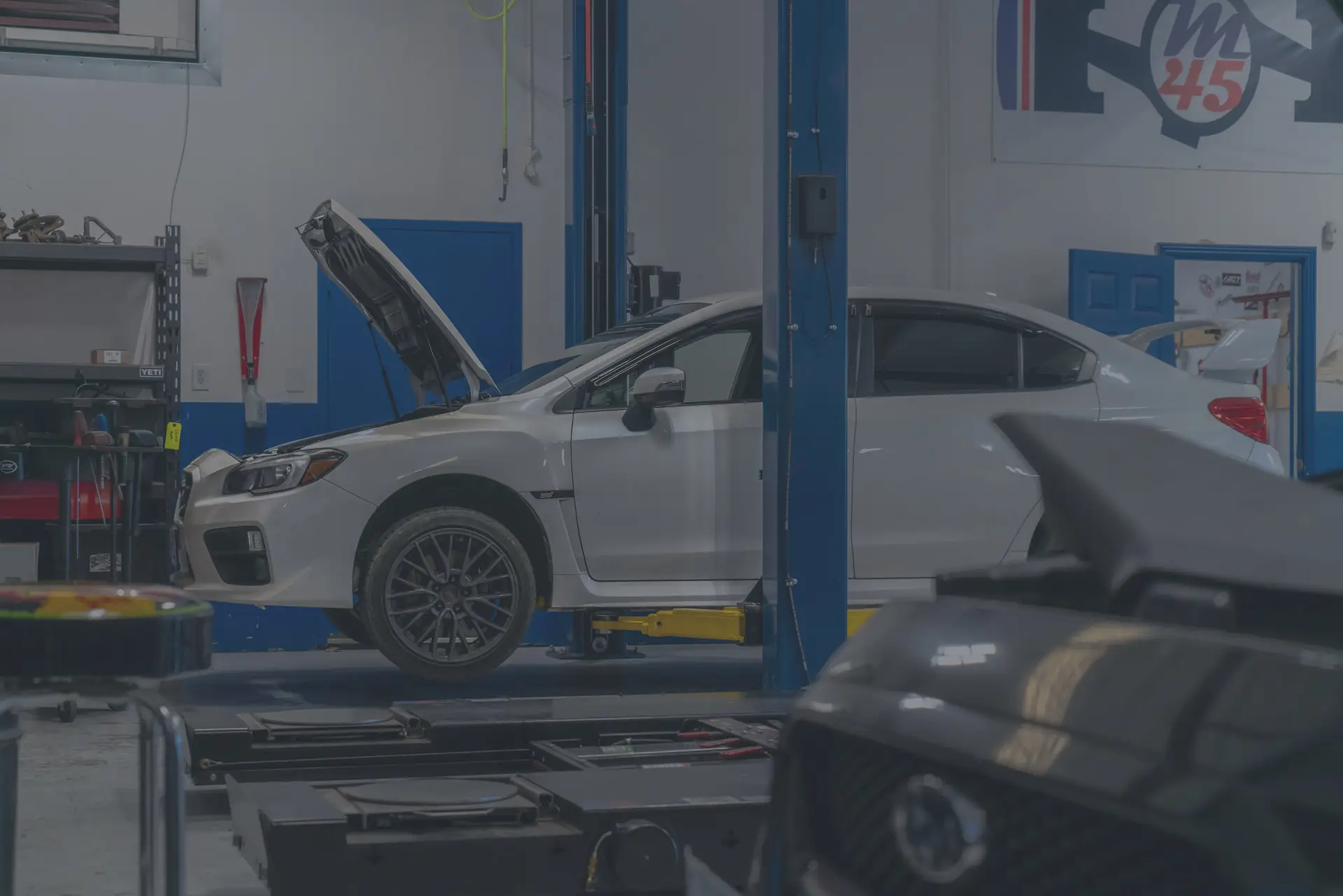
Wheel Alignment
Alignment affects how your tires wear, how your AWD system loads, and how the car handles. On a Subaru, getting it right matters more than most.
Alignment on a Subaru
Is a Four-Corner Problem.
Front-wheel-drive cars can get away with a front-only alignment check in many situations. Subaru's symmetrical AWD cannot. Misalignment at any corner stresses the drivetrain, accelerates tire wear across all four contact patches, and affects how the car handles — because the AWD system is continuously trying to balance traction across all four wheels regardless of where the geometry is off.
We perform four-wheel alignment on every Subaru — measuring toe, camber, and caster at all four corners, verifying the thrust angle, and adjusting to factory spec or a customer-specified performance setting. We also know the limits of Subaru's factory adjustment range, and we'll tell you when aftermarket camber hardware is needed to achieve the geometry your car requires.
- Four-wheel alignment on every service — all four corners measured and documented
- Before-and-after alignment printout — you see exactly what was corrected
- Factory spec or performance spec — WRX and STI alignment to your preferred geometry
- Lifted Subaru alignment — we account for suspension geometry changes from lift
- Suspension inspection before alignment — we won't align a car with worn components
- Camber hardware recommendations when factory adjustment range is insufficient
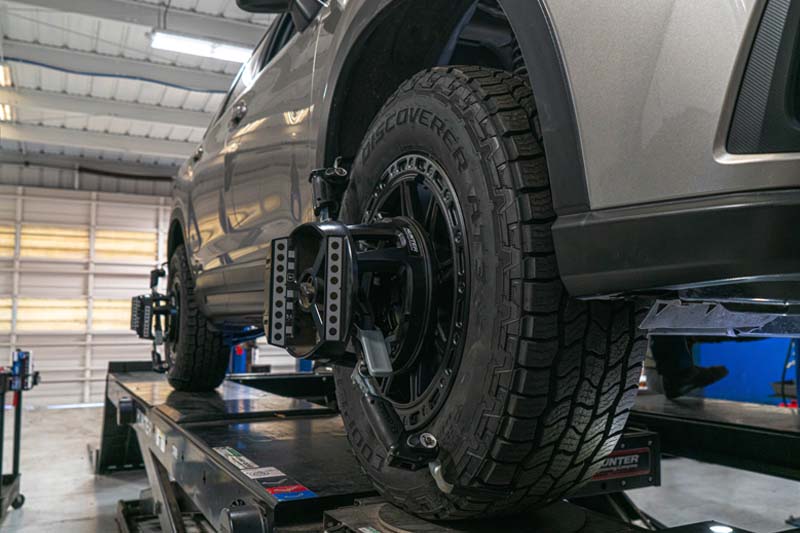
When to Get an Alignment
After an Impact
A hard hit to a pothole, curb strike, or road debris impact can shift alignment angles immediately — sometimes subtly, sometimes dramatically. If the car pulls or the steering wheel is no longer centered after an impact event, alignment is the first check. Don't wait for tire wear to confirm what the alignment rack will show you in 30 minutes.
After Suspension Work
Any time a suspension component is replaced — struts, control arms, tie rod ends, ball joints, subframe bushings — alignment must be reset. Replacing a tie rod end, for example, changes toe directly. Even a strut replacement can alter camber. We include an alignment check recommendation with every suspension repair and can often perform the alignment in the same visit.
With New Tires
Installing new tires on a car with misaligned geometry begins wearing them immediately — sometimes visibly within a few thousand miles. An alignment before or at the time of a new tire set is straightforward insurance on a significant tire investment. On a Subaru where all four tires need to be replaced as a set, proper alignment makes that expense go further.
After a Lift Install
Lifting a Subaru — even with a proper lift kit — changes the suspension geometry intentionally. Strut angles shift, camber goes positive, and the thrust line may change depending on how the rear suspension responds to the additional ride height. A post-lift alignment isn't optional; it's the step that makes the lift work correctly and prevents the accelerated tire wear that comes from running lifted suspension at factory geometry specs.
Uneven Tire Wear
Inner or outer edge wear on one or more tires is the most common indicator of a camber or toe problem that's been present long enough to show up in rubber. If you're seeing feathering across the tread face, that's a toe issue. Edge wear on one side of a tire points to camber. Wear on opposite edges of the front vs rear tires often indicates a thrust angle problem. Tire wear patterns are a forensic record of alignment history.
Annual Check
Even without a specific triggering event, alignment drifts over time through normal road use — minor impacts, bushing compliance, and seasonal temperature changes all contribute. An annual alignment check, or one at every other tire rotation, catches minor deviations before they become measurable tire wear. Auburn's roads give alignment plenty of opportunities to shift.
What Gets Measured
and Why It Matters
A complete four-wheel alignment measures and adjusts four primary angles across all four corners. Each affects handling, tire wear, and AWD load in a distinct way.
-
Toe
Whether the front of the tire points inward (toe-in) or outward (toe-out) relative to the vehicle centerline. Toe has the largest effect on tire wear of any alignment angle — even small deviations cause rapid feathering across the tread. Adjusted at all four corners on a Subaru. Front toe affects straight-line tracking and turn-in response; rear toe affects stability.
-
Camber
The vertical tilt of the tire when viewed from the front — negative camber tilts the top of the tire inward, positive tilts it outward. Factory Subaru specs run slight negative camber for balanced handling and even wear. Performance alignments for WRX and STI often target more aggressive negative camber for cornering grip. Subaru's factory rear camber adjustment range is limited — additional hardware is often needed for significant correction.
-
Caster
The forward or rearward angle of the steering axis viewed from the side. Positive caster improves straight-line stability and steering return-to-center feel. Caster is not typically adjustable on Subarus within factory parameters — significant caster deviation usually indicates a bent or damaged steering component and warrants inspection before alignment.
-
Thrust Angle
Whether the rear axle is perpendicular to the vehicle centerline. A rear axle that's pointed slightly to one side causes the car to "dog track" — the rear wheels follow a different path than the front, causing handling pull and uneven tire wear that front-toe adjustment alone won't fix. Four-wheel alignment corrects the thrust angle before setting front geometry.
Subaru-specific alignment notes
- AWD tire size sensitivity: Mismatched tires add drivetrain stress on top of any alignment issue — both should be addressed together.
- Limited rear camber adjustment: Many Subaru rear suspensions have minimal factory camber adjustment. Camber bolts or eccentric hardware may be required to achieve proper geometry.
- Lifted models: Subaru lift kits intentionally alter suspension geometry — post-lift alignment is required, and some compromises in camber are inherent to the design.
- WRX / STI performance specs: We can align to factory spec or a custom performance target — more negative camber, adjusted front and rear toe — with a printed before/after spec sheet.
- Worn components: We inspect suspension and steering components before aligning. Aligning over worn tie rod ends or control arm bushings produces an alignment that won't hold.
Alignment That Accounts
for How Subarus Actually Work
AWD-Aware Alignment
Alignment on a Subaru isn't just a handling and tire wear issue — it's a drivetrain issue. We set alignment with the AWD system's sensitivity to asymmetric loads in mind, not just the handling spec from a service manual. That means four-wheel work every time, attention to thrust angle before touching front geometry, and awareness of how lift height or lowering affects the whole system.
Street and Performance Specs
WRX and STI owners often want something other than the factory comfort alignment — more negative camber, adjusted toe for sharper turn-in, rear toe tuned for stability under power. We align to the spec you want, document it on your printout, and advise on the trade-offs between aggressive geometry and daily-driver tire wear. We work with stock suspension and aftermarket setups alike.
Before-and-After Documentation
Every alignment produces a printed before-and-after spec sheet showing every angle measured, what was out of spec, and what it was corrected to. You keep the printout — it's a record of your car's geometry that's useful if you ever need to reference what was done, compare against a future alignment, or verify that work was actually performed.
Alignment FAQ
How do I know if my alignment is off?
The most obvious signs are the car pulling to one side on a flat, straight road with your hands relaxed on the wheel; a steering wheel that's off-center when driving straight; or uneven tire wear — inner or outer edge wear, feathering across the tread, or significantly more wear on one tire than its partner on the same axle. Subtle misalignment often shows up in tire wear before it's noticeable in handling. If you're rotating tires regularly and still seeing uneven wear, alignment is the likely cause.
Does a Subaru need four-wheel alignment or just the front?
Four-wheel, every time. Subaru's AWD system means rear alignment angles directly affect how the car drives and how the drivetrain loads — a rear toe problem causes the car to crab down the road even if the front is perfect. Front-only alignment on an AWD vehicle sets the front geometry relative to a rear axle that may itself be off, producing an alignment that doesn't match what the car actually needs. Four-wheel alignment is the only complete approach.
Can you align a lifted Subaru?
Yes — and lifted Subarus in the Auburn area are a significant part of our alignment work. A post-lift alignment is required after any lift installation. Depending on the lift height and kit design, front and rear camber may be out of the factory adjustment range and require camber hardware to bring back to an acceptable spec. Some camber compromise is inherent to certain lift configurations — we'll measure what's achievable with your setup and set the best geometry possible within it, and we'll be honest about what the lift means for tire wear expectations.
What's a performance alignment for a WRX or STI?
A performance alignment targets more aggressive geometry than Subaru's factory comfort spec — typically more negative camber (–1.5° to –2.5° front depending on use), reduced front toe-in for sharper turn-in, and rear toe adjusted for high-speed stability. The trade-off is inner edge tire wear, which is more pronounced the more negative the camber. For a primarily street car, a mild performance spec balances handling improvement with acceptable tire life. For a track-focused car, more aggressive geometry may make sense with the understanding that tires wear faster. We'll talk through the options based on how you use the car.
How long does an alignment take?
A standard four-wheel alignment typically takes 45–75 minutes. If camber hardware needs to be installed, add time for parts and installation. If we find worn suspension components during our pre-alignment inspection, we'll let you know before proceeding — aligning over a worn tie rod end produces a measurement that won't hold, and it's better to address the component first than to pay for an alignment twice.