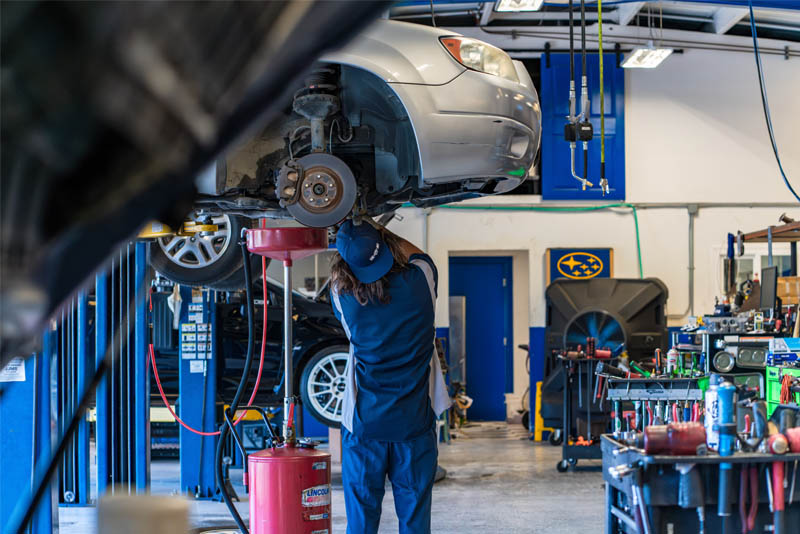
Most Subaru owners know they need oil changes. Beyond that, the maintenance schedule gets fuzzy. You drive the car, it runs fine, and somewhere around 60,000 miles you start wondering what you've been putting off.
The short answer: probably a few things. Subaru's maintenance schedule is built around specific mileage milestones, and each one covers different systems. Miss a milestone and you might not notice anything right away. But the wear adds up, and what starts as a routine, low-cost service can eventually turn into a much more expensive repair.
Here's a breakdown of every maintenance milestone that matters, what happens at each one, and why it's worth your time.
Oil Changes: Every 6,000 Miles or 6 Months
Subaru recommends oil changes every 6,000 miles or every six months, whichever comes first. All Subaru models from 2015 forward require full synthetic oil, which holds up better under heat and extends engine life compared to conventional oil.
Six thousand miles is the number, but there's a catch. If your daily commute is mostly stop-and-go through Auburn and you're making a lot of short trips, your oil breaks down faster than highway miles would suggest. Heat cycling without sustained running temperature is harder on oil than a long cruise up I-80.
What Happens If You Skip It
Dirty oil loses its ability to lubricate and cool the engine. Sludge builds up. Internal components wear faster. And if you're driving one of the 2011 to 2015 models that already burn oil between changes, running old oil on top of a low oil level is a recipe for serious engine damage.
Check your dipstick every two weeks between changes. It takes 30 seconds and costs nothing.
Fluid Inspections and Replacements
Your Subaru runs on more than just engine oil. Each fluid has its own lifespan, and they don't all wear out at the same rate.
Coolant
Subaru's long-life coolant is rated for about 11 years or 137,500 miles on the initial fill. After that first replacement, the interval drops to every 6 years or 75,000 miles. Coolant doesn't just prevent overheating. It also protects against corrosion inside the engine and radiator. Old coolant turns acidic and starts eating away at gaskets and hoses from the inside.
Transmission Fluid
Subaru recommends replacing CVT fluid at around 25,000 to 30,000 miles for vehicles driven under "severe" conditions. And if you're doing a lot of hill driving between Auburn and the Sierra, that counts as severe. Fresh transmission fluid keeps the CVT running smoothly and prevents the shuddering and hesitation that come with degraded fluid.
Brake Fluid
Brake fluid absorbs moisture over time. That moisture lowers the fluid's boiling point, which means less stopping power when your brakes get hot on a long downhill stretch. Subaru calls for brake fluid replacement at the 30,000-mile mark and again every 30,000 miles after that.
Differential Fluid
Front and rear differential fluid should be replaced around every 30,000 miles. This is one people forget because the differentials don't announce themselves when the fluid is low. But all-wheel-drive systems depend on clean differential fluid to transfer power evenly. Neglect it and you'll start hearing whining or grinding from the axles.
Brake Inspections: Every 12,000 Miles
Subaru's schedule calls for a full brake inspection every 12,000 miles. That means checking pad thickness, rotor condition, brake lines, caliper function, and the parking brake.
Brake pads on most Subarus last between 25,000 and 50,000 miles depending on how you drive. If you're commuting through Auburn and stopping frequently, you'll be on the lower end. Highway drivers who rarely touch the brakes will get more life out of a set.
What to Listen and Feel For
Squealing or grinding when you brake means the pads are worn. A pulsing or vibrating brake pedal usually points to warped rotors. And if the car pulls to one side when you stop, a caliper might be sticking.
Replacing pads when they're worn but still functional is cheap. Waiting until the pads are gone and the rotors are scored means replacing both, which doubles the cost.
Timing Belt Replacement: 105,000 Miles
This one is critical, and it only applies to Subarus with the older EJ-series engines. If your Subaru was built before 2012 (or you drive a WRX/STI with the EJ turbo engine), it almost certainly has a timing belt. Newer models with the FA and FB engines use a timing chain, which doesn't require scheduled replacement.
Subaru's official interval is 105,000 miles or 105 months, whichever comes first. That second number matters. Rubber degrades with age even if the car is sitting in a garage, so a 10-year-old Subaru with 70,000 miles still needs attention.
Why This Job Can't Wait
Every EJ-series engine is an interference engine. That means if the timing belt snaps while the engine is running, the pistons and valves collide. The result is bent valves, damaged pistons, and a repair bill that often exceeds the value of the car. A timing belt replacement is a moderate service when you include the tensioner, idler pulleys, and water pump. If the belt fails, the resulting engine damage can require a far more expensive repair, often involving a full rebuild or replacement.
We always recommend replacing the water pump, tensioner, and all idler bearings at the same time as the belt. The labor to access these parts is the expensive part. Once we're in there, the cost of the additional parts is small compared to doing the job twice.
Battery Maintenance: Check Annually, Replace Every 3 to 5 Years
Car batteries don't give you much warning before they die. One morning the car starts fine, and the next morning it doesn't. Auburn's summer heat is especially hard on batteries. Temperatures above 100 degrees accelerate the chemical breakdown inside the cells.
We test batteries during every routine service visit. A load test tells us how much capacity is left and whether the battery is on its way out. If your battery is older than three years, it's worth testing every six months.
Signs Your Battery Is Fading
Slow cranking on startup is the most obvious sign. Dimming headlights at idle, electrical gremlins like flickering dashboard lights, and needing a jump start even once are all signals that the battery is losing capacity. Don't wait for a no-start situation in a parking lot.
Suspension and Steering Checks: Every 12,000 to 15,000 Miles
Subaru's maintenance schedule includes suspension and steering inspections at regular intervals, but driving conditions around Auburn accelerate wear on these components. Potholes on Highway 49, gravel roads toward the American River, and seasonal freeze-thaw cycles all take a toll.
What We're Looking At
During a suspension check, we inspect struts and shocks for leaks and loss of damping, control arm bushings for cracking and play, sway bar end links for looseness, tie rod ends for wear, and ball joints for excessive movement. We also check alignment specs, because worn suspension parts throw alignment off and chew through tires.
Most of these components wear gradually. You won't feel a sudden change. Instead, the steering gets slightly vaguer, the ride gets slightly rougher, and your tires start wearing unevenly on one edge. A quick inspection catches these issues before they compound.
Engine Air Filter Replacement: Every 12,000 to 15,000 Miles
Subaru recommends inspecting the engine air filter at every service and replacing it around every 12,000 to 15,000 miles. If you drive on unpaved roads regularly (and plenty of Auburn-area Subaru owners do), that interval should be shorter.
A clogged air filter restricts airflow to the engine. The result is reduced fuel economy, sluggish acceleration, and in some cases, engine misfires. It's also one of the cheapest maintenance items on the car. There's no reason to stretch it.
Don't forget the cabin air filter either. It sits behind the glove box and filters the air coming through your vents. Subaru recommends replacing it every 12,000 miles. If your AC smells musty or your airflow seems weak, that filter is probably overdue.
Comprehensive Vehicle Inspections: 30,000 / 60,000 / 90,000 Miles
The big three. These are the milestones where everything gets checked, and specific components get replaced on schedule whether they look worn or not.
30,000 Miles
This is the first major service. On top of your standard oil change and tire rotation, the 30,000-mile service adds spark plug replacement, transmission fluid exchange, differential fluid service, brake fluid replacement, and a thorough inspection of the braking system, drivetrain, and exhaust. Think of it as the first real deep look under the car since you bought it.
60,000 Miles
Everything from the 30,000-mile service, plus closer attention to components that have now seen significant wear. Battery testing becomes more important here. Drive belts should be inspected for cracking and glazing. Coolant condition gets checked. If your Subaru has a CVT, the transmission fluid exchange is especially important at this interval.
90,000 Miles
The 90,000-mile service mirrors the 30,000-mile service with additional scrutiny on high-mileage wear items. Spark plugs get replaced again. All fluids get exchanged. And if your Subaru has a timing belt, you're now 15,000 miles from the replacement deadline. We'll inspect the belt and let you know whether it makes sense to do it now or schedule it for the 105,000-mile mark.
A Simple Way to Stay on Track
You don't need to memorize every interval. The pattern is straightforward: oil change and basic inspection every 6,000 miles, a more thorough check every 12,000, and a comprehensive service at 30, 60, and 90 thousand. Timing belt at 105,000 if your engine has one.
Keep a record of every service. A documented maintenance history protects your warranty coverage, supports your car's resale value, and gives any shop working on the car a clear picture of what's been done and what's due next.
If you're not sure where your Subaru stands on the maintenance schedule, bring it by M45 Automotive. We'll pull it into the shop, tell you exactly what's current and what's overdue, and help you prioritize the work that matters most. No pressure, no unnecessary upsells. Just a clear picture of what your car needs to stay on the road for another 100,000 miles.